Wednesday, November 3, 2010

Who Am I?


            Hi to who is visiting my blog. My name is Yee Hon Kit, or better known as Leon, a 21-year-old Chinese boy. I was born in a city in Pahang – Kuantan. I come from a simple family of five - My parents, me, 19-year-old and 17-year-old sisters. I am the eldest son in my family. My father is an insurance agent while my mother is a professional housewife who has to work for 365 days; Both of my sisters are going to sit for STPM and SPM at the end of this year. My family is everything to me now and I love my family.

            Next is about my educational background, I had my primary education in SRJK (c) Pei Chai and secondary school in SMK Air Putih. Then, I have finished my Form Six life in SMK Sultan Abu Bakar. I have really enjoyed my past time at school. I have learned many things from my friends and my teachers especially in the ways of motivating oneself. I still remember the time when I first entered secondary school, as I am not a very hardworking and self-esteem person, i am not excel in academic. Fortunately, thanks to good peer pressure and motivation from my teachers, I have been able to maintain my results throughout the years in secondary school. Possibly I wouldn’t have attained good result in PMR (8A) and SPM (8A) without them. My secondary school life had really changed me a lot for who I am today.

            Currently, I am continuing my study for Bachelor degree in University Pendidikan Sultan Idris(UPSI), which located at Tanjung Malim, Perak. I am majoring in Biology and taking TESL as minor. College life wasn’t as easy as I thought. My first year of college life was clouded with assignments, projects and programmes. However, the hardest part would be the interpersonal relationship – reliance, communication and teamwork. Fortunately, I am quite a tough person with strong personality. I believe obstacle and hardship will make one grow stronger and wiser. One of the important lesson that I have learned from my college life is that never doubt your decision before others does. One must always have their own opinion regardless in handling whatever situation. For this, people will only respect and believe in you. My writing should end here. If you wish to know me more, kindly do visit my blog or further knowing me personally, as I am a anti-social person after all. Wish all have a nice day.


Educational Essay - Knowledge Is Not Power

Knowledge is Not Power - Application of Knowledge is Power

As a teacher, what makes you distinctive among other teachers? Yes, is your teaching philosophy. Education is supposed to be about effective teaching and effective learning. Therefore, my teaching philosophy values the interconnectedness of theory, practice and reflection. Quality teaching is from theory into practice. “Knowledge is Not Power - Application of Knowledge is Power”.
Every year, it isn’t a surprise that the newspapers published on how many A’s our brilliant students can achieve in just a single examination. They really all-rounded or it is just an illusion of the exam-oriented culture? Under examination-oriented education system in Malaysia, grades are all that matters. It is not wrong to say that students nowadays are studying for A’s rather than to gain knowledge. Students are forced to know and learn everything their study by heart in order to get good grades during examination. They are often trained to become a scanner or photocopier that memorise all the facts and info without digesting the real content. For them, the ultimate goal is just to vomit everything out in the exam hall and get good grades. However, it isn’t the purpose of education.
Our education system pays more attention to the theory learning. Teachers always emphasize the concepts existed in the books, and put it in the second place that how to cultivate the ability of adapting theory into practice, which make us more familiar with the theory, but low ability in the practice. The teachers teach theories but do not care about how the theories should be used in practice. Hence, we should turn theory into practice. As the saying goes, “Tell me and I forget. Show me and I remember. Involve me and I understand.”
Theory and practice are not opposites or separate entities.  'Practice' cannot be lacking theory.  Similarly, it is difficult to conceive of 'theory' that is purely descriptive and devoid of reference to purposeful action.  In other words, practice is soaked in theory.  It is a constant process of theory making, and theory testing. 
Practice is often portrayed at a very simple level as the act of doing something.  It is frequently depicted in contrast to something called theory - abstract ideas about some particular thing or phenomenon. I would like my students to adapt the theory into practice. They learn the theory in school and then able to apply it to the situations in their daily life. Theory should be a 'real' knowledge while practice is the application of that knowledge to solve problems. Learning how to apply any knowledge you gain is important to your success. Gaining knowledge is pointless if you're not properly using it. Application of knowledge takes practice and you must do it daily. Knowledge is Not Power - Application of Knowledge is Power.
An old Chinese proverb says, "A teacher for a day is like a parent for a lifetime." My students are my academic "children," and when they grow intellectually I value my part in contributing to that growth.


From http://www.lihunwong.blogspot.com/

My Resume


Name
Yee Hon Kit

Gender
Male

Age

21 years old

Nationality

Malaysia

Date of birth

17 August 1989

Place of Birth

Hospital HTAA, Kuantan, Pahang

Address

No.7 ,Lorong Bukit Ubi 50 ,Taman Bukit Ubi Jaya ,25200 ,Kuantan ,Pahang

Current Address

No,25, Jalan Universiti 1/2, Taman Universiti Baru, 35900 Tanjung Malim, Perak

Email

leonforever@live.com.my

Hobbies

Listening to music and outdoor activities

Educational background

- Kindergarten
1994: Fong Kindergarden ,Kuantan

- Primary School

1996-1998: SRJK Pei Chai

- Secondary School

2002-2006: SMK Air Putih
2007-2008: SMK Sultan Abu Bakar Shah

-University

2009-~~~~: Universiti Pendidikan Sultan Idris (UPSI),Tanjung Malim, Perak.

Monday, November 1, 2010

Official UPSI Logo and Song


IBU KANDUNG SULUH BUDIMAN

Ibu Kandung Suluh Budiman
Obor Di malam Gelap
Bina Budi Penyebar Tekad
Pancaran Semangat Waja

Ibu Kandung Suluh Budiman
Ibu Pujaan Kami
Yang Berjasa Pada Masyarakat
Hidup Gagah Berani

Ibu Kandung Suluh Budiman
Dengarlah Sumpah
Sumbangsih Nan Suci
Selagi Hayat Dikandung Badan
Kami Tetap Berbakti

Video + Lagu Ibu Kandung Suluh Budiman

Other Certificates

Program Pembersihan Sungai Samak 2009

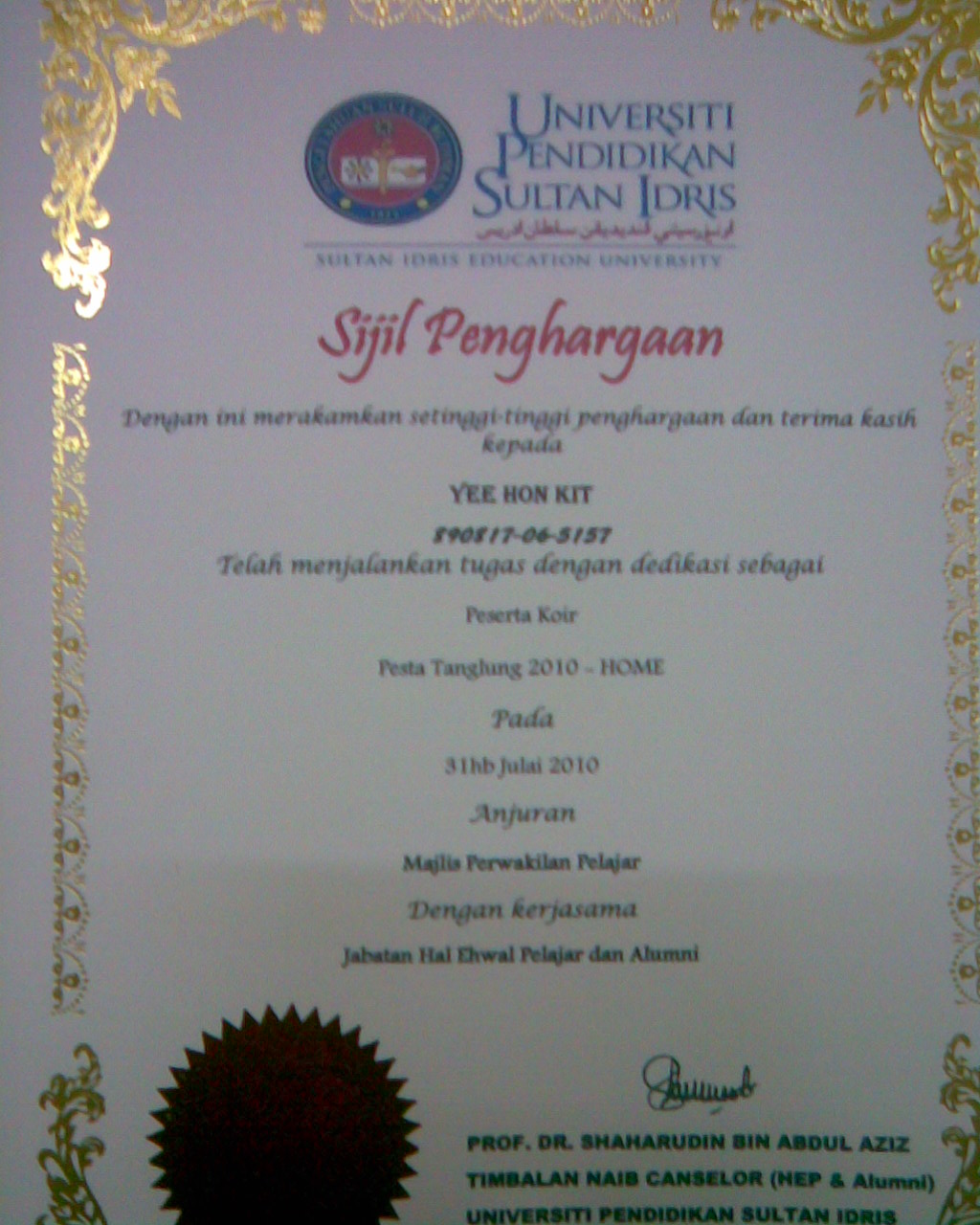
Peserta Koir Pesta Tanglung 2010

Dean's List

Semester 1 Sesi 2009/2010
Semester 2 Sesi 2010/2011
                                                

Details about State of Matter 's Simulation


         This chemistry simulation is related to the topic state of matters. This simulation will explain the solid, liquid and gas molecule arrangement changes when different  temperature and pressure are applied on different type of molecule such as neon, argon, oxygen and water.

         Simulations can be particularly advantageous for basic scientific ideas. This simulation can helped students to improve their understanding of science ideas about states of matter more effectively compared to the use of non-ICT teaching activities. Students can only imagine the arragement of matters when using non-ICT teaching activities. This simulation can help students be able to  demonstrate their knowledge of the states of matter through illustrations and descriptions. 

         Student cannot see the atoms or the arrangement of atoms by the naked eyes. They can only imagine after teacher explain about the arragement of atoms. The benefit of using this simulation compared to traditional teaching method is students can see how the arragenment of different molecules in a solid, liquid and gas vary compare to each other. The effect of varying the temperature and pressure changes the behavior of the molecules can be see clearer by using this simulation. 
  
         Besides that, the experiment which control the temperature and pressure until too high or low cannot be conduct in normal lab. By using this simulation, the changes of temperature can be control by adding or removing heat by adjust the heat control. For example, the temperature can be adjust until more than 100 degree celcius which are very difficult to conduct in lab. While the changes of pressure can be control by adding or removing molecules or heat by pressing the button. The students can see the effect clearly and can learn better .

Details about Faraday’s law modelling.

           This physic modelling is uses both Faraday’s Electromagnetic Lab and Faraday’s Law modelling, whereby it also relates other topics such as magnetic field and magnets. This modelling will explain what happens when the magnet moves through the coil at different speeds and how this affects the brightness of the bulb and the magnitude & sign of the voltage. It also explains the difference between moving the magnet through the coil from the right side versus the left side and the difference between moving magnet through the big coil versus the smaller coil. Thus, the variables that we control in this modelling are speed and the poles of magnet when moving through the coil and the size of coil which different in size.
 
           The students will use the modelling to learn the goals through an inquiry approach. Students will be able to identify equipment and conditions that produce induction, compare and contrast how both a light bulb and voltmeter can be used to show characteristics of the induced current, predict how the current will change when the conditions are varied, explain practical applications of Faraday’s Law and explain what the cause of the induction is.

           The advantage of this modelling compared to the traditional experiment is time and cost-saving . As traditional experiment will require equipment such as magnet, variety of coils, power supply, overhead galvanometer, little demo light bulb, generator model. Moreover, these equipment must be in good condition in order to get consistent and accurate result. On the contrary, this modelling will show accurate and consistent result at all time. This modelling also allow every student to participate for this experiment and provoke their understanding more easily as they can see the result significantly and are able to compare their result with one another for analysis of this experiment.

Link- http://phet.colorado.edu/en/simulation/faradays-law

Modeling

Simulation

Misconception- Cell Division

Data Logger (Engage, Empower, Enhance & Extension)

Smart School PBL

Forum Essay- Challenges of ICT Integration in Smart School


            ICTs stand for Information and Communication Technologies . The Information and Communication Technologies (ICT) is an umbrella term that includes any communication device or application which include computers, the Internet, broadcasting technologies (radio and television), and telephony. The use of information and communication technologies in education makes teaching – learning process effective and interesting. However, there are some issues and challenges integrating ICT in teaching and learning in our Malaysian Schools.

            Teachers with ICT skills is the very first challenge that we meet in integrating ICT in teaching and learning in our Malaysian Schools. Lack of teachers equipped with ICT skills is a significant problem for the use of ICT in education. The institutes where ICT is going to be integrated in education, first of all their teachers must be well trained about ICT tools in education. Before going to teach to students, teachers must know about how and when to use ICT tools to achieve particular purposes. Ideally, these should be addressed in pre-service teacher training and built on and enhanced in-service. ICTs are evolving technologies, and so even the most ICT fluent teachers need to continuously upgrade their skills and keep abreast of the latest developments and best practices .

            However , managing the change is one of the biggest problems, as teachers nowadays don’t accept change easily. In general a large number of teachers in educational institutes are non ICT proficient, and resistance to change. The strategy of adding technology to the already existing activities in institutes and in the classroom, without changing habitual teaching practices, does not produce good results in student learning .The reason for this is due to the fact that the vast majority of teachers are not proficient users of technology, especially computer technology. It is believe that the major obstacles are due to the lack of resources and training. In a nut shell ,teacher professional development should have skills in teaching the students using the ICT with particular application.

            Another challenge that relate to the integration of ICT in teaching and learning in our Malaysian Schools is the availability of information and communication technologies infrastructure. Appropriate rooms or buildings available to house the technology and the equipments such as computers as well as affordable Internet service for online learning are basic needs to initiate any  ICT-based program.
            Before any ICT-based program is launched, associate planners and the government agencies should look deeply into the cost-effectiveness in financing any ICT-enabled programme over the long term as technology investments typically run high and in many cases divert funds from other equally pressing needs .Moreover, planners should also factor in not just costs but also the availability of spare parts and technical support. These factors are the key to maintain while also to guarantee the sustainability and efficiency of ICTs ’ integration in schools. However ,despite important factor of funding, many other factors must be taken into account before and during the implementation of academic computing initiatives. Failure to address important issues may result in wasted resources and ineffective implementation.

            The present age is the age of technology, whereby technology plays a key role not only in our daily lives but also globally, this includes the education system. There are endless possibilities with the integration of ICT in the education system. The use of ICT in education not only improves classroom teaching learning process, but also provides the facility of e-learning. Although the implemention of ICT in our education system is a long and expensive process, none of us can denied the fact that integrating ICT in teaching and learning in our Malaysian schools is vital and beneficial for future generation. Moreover ,it is a good way to increase the development in Malaysia. Hence ,It is important that teachers or trainers should be made to adopt technology in their teaching styles to provide pedagogical and educational gains to the learners which will progessively ensuring the achievement of vision 2020.


Reflection on ICT lessons


           First of all, thousand thanks I would like to give to our ICT lecturer, Dr Sopia for her dedication and guidance in teaching us about ICT lessons. Dr Sopia has been a great lecturer who inspired me a lot, either in ways of thinking or in the way we as a university student should be.

           For the past 14-weeks, one of the most challenging ICT lessons which I have faced much trouble is about the Engage, Empower and Enhance model. In my opinion, this model allows teacher to ‘build’ more knowledge based on student prior knowledge in certain topic and is able to stimulate their critical thinking. Moreover, this model utilized data logger, an intelligent data processor which can pair up with maximum 3 different sensors such as pressure, carbon dioxide and light to carry out an experiment more efficiently and easily, giving more advantages to both teacher and his student.

            However, everything has its pros and cons. I discovered that in implementing and presenting this model, one must follow exactly every instructions and steps in order to come out with the best result, which I think this model is lack of flexibility. For instance, the way we ask question in Engage is fixed. One must not relate with scientific words in Engage and yet must be able to stimulate thinking, drawing a student interest at the same time. A good teaching model should fit teacher well, not the other way round whereby a teacher have to fit according to the model. As this will restrict creativity development in time. Moreover, this model is discussed in group, we found that we have difficulties in deciding which of our ideas is the best to present in implementing this model.

            Aside that, regarding to the suitability and usefulness of data logging, simulation and modeling in addressing students ‘ problems in learning, in my opinion, it is undeniable that all these 3 new teaching models have many benefits for both teacher and student such as time-saving and provoke students ‘ understanding through visualization, at the same time, having a huge potential to be implement in every school. However, in integrating these teaching model in the classroom, these teaching models are only limited to certain topic. Moreover, only good and well-plan teaching model can really help students to overcome their problem in learning.  Hence, in the of implementing these teaching models in school, a set of good chosen teaching model examples and trained teachers are required.


Wednesday, September 29, 2010

Curriculum Specifications

  1. Biology Form 4
  2. Biology Form 5
  3. Biology Form 6

Photo Gallery

Bangunan E- Learning


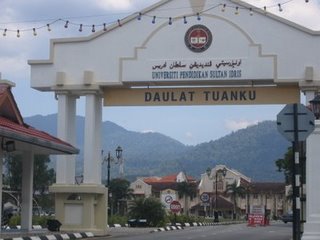
Pintu Utama

Dewan Peperiksaan

Perpustakaan

Pintu Utama

Kompleks Malim Sarjana

Bangunan Suluh Budiman

Bengkel Kemahiran Hidup

Bas Perhentian Pintu Timur

Sunday, August 22, 2010

Universiti Pendidikan Sultan Idris


Background

Universiti Pendidikan Sultan Idris was established on 1st May 1997 based on Government gazette P.U.(A) 132 & 133 dated 24th February 1997 under the Order of Universiti Pendidikan Sultan Idris (Corporation) and the Order of Universiti Pendidikan Sultan Idris (Campus) 1997. However, the history of this University dates back to 1922 when the University was then known as Sultan Idris Training College (SITC).

SITC was set up by the British government and it was the brainchild of the Deputy Director of Malay Schools, Sir Richard Winstedt. SITC was officially opened on November 29, 1922 by the Chief Secretary to the Federation of Malay States, Sir George Maxwell, making it the highest institution of learning exclusively for the Malays at that time.

Graduates of this institution were greatly respected and honoured by the society as it was renowned for producing prominent figures like the ‘Father of Modern Malay Language’, Zainal Abidin Ahmad or popularly known as Za’ba, novelists like Harun Aminurrashid, and Ahmad Bakhtiar and legendaries such as Ibrahim Yaacob and Aminuddin Baki. Tan Sri Awang Had Salleh, a national figure in the field of education and not forgetting the Former Deputy Prime Minister of Malaysia, Tun Abdul Ghaffar Baba are also the ‘products’ of SITC. To many, SITC was regarded as the birthplace of Malay nationalism.

In the early days, students of SITC had to undergo a three-year training course, where they learnt traditional skills and arithmetic. These students were under the tutelage of its teaching staff comprising of four Europeans, one Filipino and ten Malays.

After the 1957 Razak Report, new subjects were introduced and the training course was extended to five years. In addition, the name of the college was changed to Maktab Perguruan Sultan Idris (MPSI).

Traditionally, MPSI accepted only male students. However, in 1976 it began to open its door to the female population admitting its first batch of 150 female students. 1n 1987, the Minister of Education bestowed the institute status upon the country’s oldest teacher training college, and MPSI was thereafter referred to as Institut Perguruan Sultan Idris (IPSI). With its new status, IPSI started to introduce new courses including a twinning programme with Universiti Pertanian Malaysia (currently known as Universiti Putra Malaysia). By then, the number of students, lecturers and support staff had increased in tandem.

It is the aspiration of the Ministry to have only graduate teachers spearheading both the primary and secondary schools in Malaysia. Thus, in order to realise such noble dream, the Ministry of Education granted the university status to IPSI on 1st May 1997.

THE CAMPUS

Sultan Abdul Jalil Shah campus is located at the border of Perak and Selangor in Tanjong Malim on a 33ha of land. However, the ground breaking ceremony of the new Sultan Azlan Shah campus has taken place on 24th April 2002 by His Royal Highness the Sultan of Perak, Sultan Azlan Muhibbuddin Shah Ibni Almarhum Sultan Yussuf Izzuddin Shah Ghaffarullahu-lah. The new campus will be built on an 800 acres of land located at Behrang Ulu, 5km from its current campus.


UPSI Philosophy
Menginsafi Bahawa,
       Pertama, fungsi sesebuah Universiti bukanlah sekadar menguruskan program-program latihan, tetapi lebih penting daripada itu, ialah mengendalikan sebuah proses pendidikan ke arah pembinaan dan pengukuhan sebuah peradaban, sama ada secara ketera ataupun tersirat ;
       Kedua, Universiti adalah sebuah lanjutan kepada kesinambungan sebuah tradisi pendidikan perguruan yang berusia lebih lapan dekat dengan kebitaraan dan kecemerlangannya yang tersendiri ;
       UPSI sambil mengiktiraf kekuatannya dalam sejarah bangsa dari segi sumbangannya bagi tempoh hampir satua abd, hendaklah juga menginsafi hakikat yang ia harus terus hidup dalam seni perubahan yang semakin pesat dalam era ini.

Maka,
       Melewati fungsi utamanya untuk melahirkan lulusan bagi mengisi keperluan sumber daya manusia yang mencukupi bagi negara, Universiti hendaklah menjadikan dirinya bertanggungjawab untuk mendidik pelajar-pelajarnya malah seluruh anggota masyarakat Universiti sendiri - memiliki ciri-ciri berikut :
·        Pertama, beriman sejati, berkeperihatinan atas kesucian ilmu dan pengetahuan, kebijaksanaan dan berkeikhlasan intelek, berperikemanusiaan dan bertatalaku mulia ;
·         Kedua, bersifat patriotis dan nasionalis yang sihat dan liberal serta bersifat celik budaya, celik agama dan celik global.
       Matlamat terakhir UPSI adalah emnjadikan anggota masyarakatnya, terutama sekali pelajar-pelajarnya, berimbang perkembangan minda, jiwa, jasmani dan rohaninya, serta berpeluang merealisasi diri sendiri sebagai individu dan memperkembangkan diri sendiri sebagai anggota yang bertanggungjawab kepada masyarakat dan negara serta dunia dan alam sejagat.
        Ke arah itu, Universiti meletak keutamaan tertinggi ke atas KEIMANAN,   KEILMUAN, KEBUDIDAYAAN, KETAMADUNAN, KEMANUSIAAN, KEMASYARAKATAN dan KENEGARAAN. Dalam mendekati matlamat falsafah ini, Universiti menitikberatkan KECEMERLANGAN dalam setiap bidang aktivitinya.


Vision, Mission & Moto of UPSI
Visi
Menjadi Universiti yang bitara, cemerlang dalam kepimpinan pendidikan berlandaskan kegemilangan sajarah serta menerajui perubahan global.

Misi
Menjana dan menatar ilmu menerajui pengajaran, penyelidikan, penerbitan, perundingan dan khidmat masyarakat, dalam konteks pembangunan insan untuk mencapai wawasan negara.

Moto
"Pendidikan Gemilang menuju Wawasan".